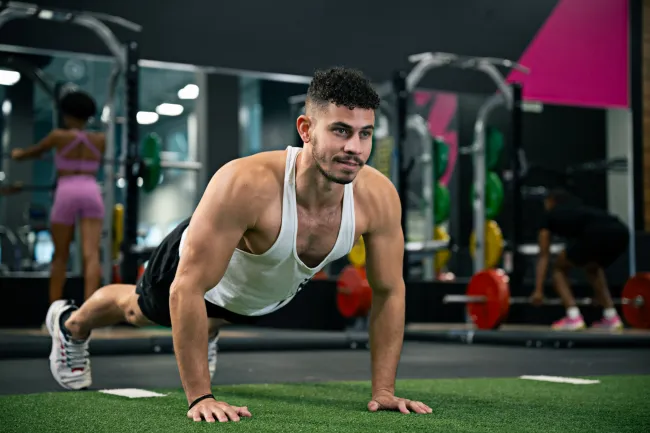
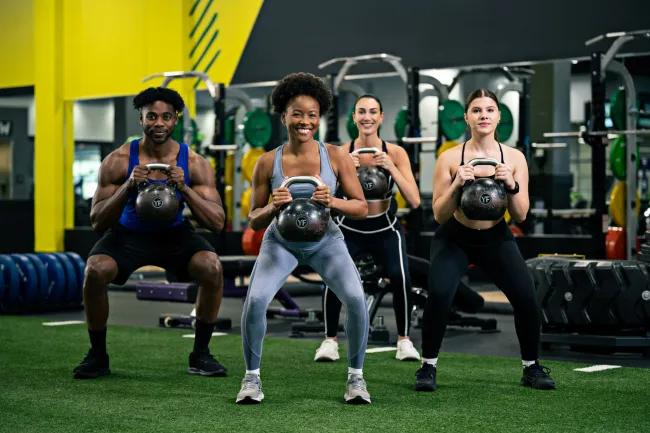
You walk into YouFit Gyms, ready to work, but you can't shake that something has been off lately. You've been putting in the work, but you're not seeing or feeling the progress you've come to expect.
When this happens, more weight and reps probably aren't the answer. Sometimes, improving your workout starts with changing how you move. And that's where neuromuscular training comes in.
What Is Neuromuscular Training?
Neuromuscular training is exercise designed to challenge the way your nervous system and muscles work together as you move.
Let's think about this with one of the most recognizable exercises: a squat.
Your body has a lot to coordinate at once with this simple movement. Your hips and knees bend, your core helps stabilize your torso, your feet stay planted on the floor, and multiple muscles work together to lower and raise your body. Your nervous system and muscles work together to make sure that you stay balanced, in position, and that the right amount of force is applied.
Neuromuscular exercises challenge your:
- Balance
- Coordination
- Stability
- Body awareness
- Movement control
- Muscle activation
Why Neuromuscular Training Matters
Your muscles don't work by themselves. Successful movement requires your brain, nervous system, muscles, and joints to coordinate.
Practicing these controlled movements has several long-lasting fitness benefits:
Better Balance and Stability
Balance is critical for everyday life. You use it when you walk, run, climb stairs, change direction, and even when you lift weights.
Better Coordination
Coordination is essential. You use it every day, whether you're standing on your tiptoes to reach your favorite mug or bending down to pull a weed out of your garden. Practicing movements with good technique can make that coordination feel more natural over time.
Greater Body Awareness
Have you ever performed an exercise and wondered, How is this helping? Body awareness can help with this. Paying attention to your positioning and movement can make it easier to recognize whether you're performing an exercise as intended.
More Intentional Workouts
It's easy to rush through a workout. But neuromuscular training encourages you to pay attention to each rep, maximizing your performance and gains. This doesn't mean that every exercise should be painfully slow. It simply means being aware of your form, maintaining control, and understanding what you're trying to accomplish with each exercise.
4 Neuromuscular Exercises to Improve Muscle Activation and Control
These four simple neuromuscular exercises can be added to a warm-up or incorporated into your existing routine.
1. Single-Leg Balance
Single-leg balance is a simple way to challenge stability and body awareness.
How to do it:
- Stand tall with your feet about hip-width apart.
- Shift your weight onto one leg.
- Lift your opposite foot slightly off the floor.
- Keep a soft bend in your standing knee.
- Brace your core and maintain an upright posture.
- Hold for 20-30 seconds.
- Switch sides.
Once you can maintain your balance comfortably, you can make the exercise more challenging by changing your arm position or carefully adding movement. Focus on staying in control rather than on how difficult you can make the exercise.
2. Glute Bridges
Glute bridges are a simple glute activation exercise that can help you practice intentionally engaging your glutes.
How to do it:
- Lie on your back with your knees bent.
- Place your feet flat on the floor about hip-width apart.
- Brace your core.
- Press through your feet and squeeze your glutes as you lift your hips.
- Pause briefly at the top.
- Lower your hips under control.
Aim for 10-15 controlled repetitions. Your goal isn't to lift your hips as high as possible. Focus on maintaining control and feeling your glutes contribute to the movement.
3. Clamshells
Clamshells target muscles around the hips and can be useful as part of a lower-body warm-up.
How to do it:
- Lie on your side with your knees bent.
- Keep your heels together.
- Brace your core and keep your hips stacked.
- Lift your top knee without allowing your torso or pelvis to roll backward.
- Lower slowly.
- Complete 10-15 repetitions before switching sides.
4. Bird-Dog
The bird-dog challenges core stability and coordination.
How to do it:
- Start on your hands and knees.
- Position your hands underneath your shoulders and knees underneath your hips.
- Brace your core.
- Extend your right arm forward while extending your left leg behind you.
- Keep your torso as still as possible.
- Return to the starting position.
- Repeat with your left arm and right leg.
Perform 8-12 controlled repetitions per side. Think about reaching long rather than trying to lift your arm or leg as high as possible.
Can Neuromuscular Training Help You Break a Workout Plateau?
If you've hit a workout plateau, your first instinct might be to add more weight, more exercises, or more training days, and sometimes that works, but at other times…
If you've hit a plateau, ask yourself:
- Am I performing each exercise with good technique?
- Am I controlling the weight or rushing through my reps?
- Do I understand which muscles I'm trying to train?
- Is my program still appropriate for my current goal?
Improving your movement quality won't magically solve every workout plateau, but putting in a more intentional effort is a smart place to start.
Put Neuromuscular Training Into Practice at YouFit
At YouFit Gyms, our team is here to make fitness more approachable, whether you've been training for years or are brand new to the fitness scene. Our personal trainers can help you understand technique, choose movements that fit your goals, and build a workout plan that makes sense for you.
If you're ready to put your mind and muscles to work, find a YouFit Gyms club near you!